

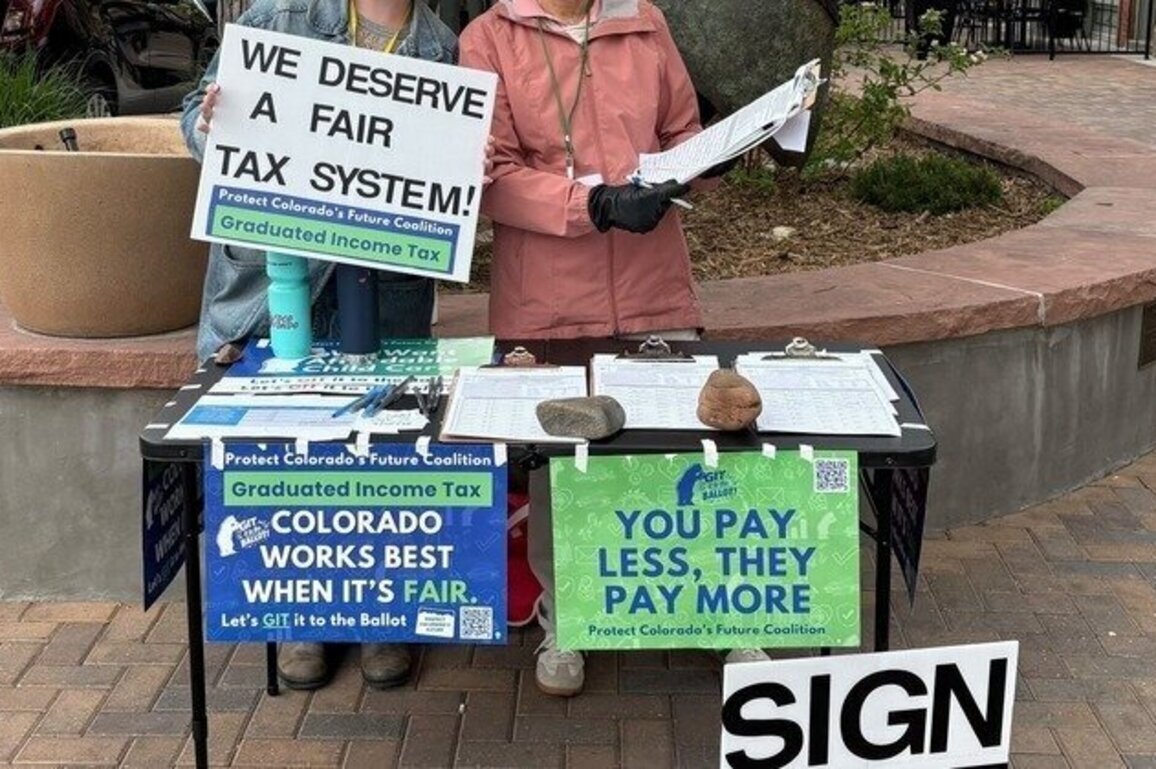
Canvassers are racing to gather signatures for measures they hope to place on Colorado’s November ballot, including a proposal to replace the state’s flat income tax with a graduated tax.
Charlie Kestler, community justice manager for Provecho Collective, is among those trying to persuade voters to support Initiative 195. The measure would raise taxes on individuals earning more than $500,000 a year, while lowering taxes for most Coloradans.
Kestler said the change would allow the state to invest in areas supporters say are chronically underfunded, including childcare, education and healthcare.
If passed, the measure "is going to raise around $2 billion for the state,” Kestler said. “We're really hoping some of that will go towards teacher pay and making sure we have smaller classroom sizes for kids.”
Initiative 195 was launched by Protect Colorado's Future, a coalition of community, grassroots and policy organizations. The measure would cut taxes for 97% of Coloradans.
The top 3% of earners would see their tax rates rise from the current 4.4% to as high as 8.4% for people earning more than $1 million a year.
Supporters of flat taxes have argued they make the tax code simpler and that it is fair for people to pay the same percentage in taxes regardless of income.
More than two-thirds of states use a graduated income tax, in part to slow income inequality. Colorado did the same until 1987, when the top rate was 10%.
The flat tax became part of Colorado’s constitution when it was folded into the Taxpayer’s Bill of Rights.
Kestler said that when income, gasoline and sales taxes are added together, lower-income workers pay a higher share of their earnings in taxes — and much more of their total income on essentials.
“If you look at the total amount of taxes that everyone pays as a percentage of their income, the wealthiest people are actually paying the smallest amount of their total income in taxes,” Kestler said.
Canvassers must collect at least 125,000 qualifying signatures, including 2% of all registered voters from every state Senate district, to make the November ballot.
Kestler said the coalition will need to put clipboards into the hands of many more volunteers to meet its July 13 deadline.
“It has actually been a lot of fun being out in the field talking to people,” Kestler said. “Canvassing is, I thought it was going to be really nerve-wracking. But it's been surprisingly just a very fun part of the campaign for me.”
Source: Public News Service